Low Oustanding Debt
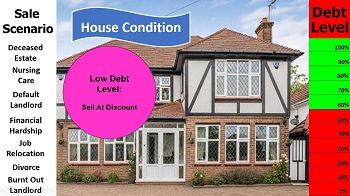
You will almost always find, irrespective of house condition, that a motivated seller will accept a discounted offer because there is still a substantial amount of cash remaining after the sale completes.
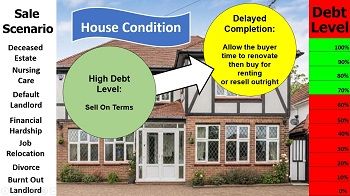
Where the property is in need of cosmetic repairs that can be quickly completed to upgrade its value, then you can be suggesting a extended completion that benefits you prior to implementing your end strategy, like selling or renting.
That can be cost saving, and you can compensate the seller accordingly, depending on the time you take. We discuss this below.
Moderate Oustanding Debt
With low outstanding debt, the seller could still walk away with money in hand, and the “hit” would be lessened if there were multiple beneficiaries, as with a deceased estate or divorce. However, let’s say that the debt level is around 50% or more, that same discount cuts much deeper into any remaining cash after the sale!
Only by understanding all three sale elements can you determine if a creative approach opens up opportunities that otherwise wouldn’t exist. What you are going to find is that for any creative approach to work, there must be no forward-chain purchase involved with the seller.
You are going to need contractual documents in place that allow you to protect your exposure prior to any subsequent action, like a delayed completion, option to buy, resale clause prior to completion, etc. Again, without completing the purchase, many standard costs like stamp duty (SDLT) or 25% mortgage deposits can be deferred, or even bypassed, from which you can financially incentivise the seller to work with you.
High Oustanding Debt
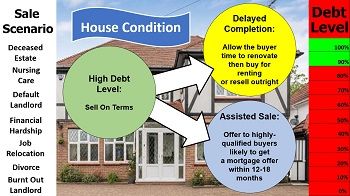
This is where the “creative thinking” begins, and you are one of few people that can offer a solution, make a profit, have no personal financial exposure, and solve a seller’s problem all at the same time! By now, options are running out, there is not enough discount available to pay everyone off post-sale, and the seller may walk away with little or nothing, or have to write a cheque to cover any outstanding debt.
What we do next is repurpose the house from the “supermarket” grocery item to the “convenience store” item. Maybe there is possible uplift value on the house, perhaps not. But by making this house easy to sell, we make it easy to buy, and the person buying does not have to jump through mortgage application “hoops” to start the buying process ahead of any mortgage approval. The implementation strategy here is a very direct sales process that enables the transaction to complete as soon as possible, typically within 18 months or less.
Conclusion
What I have described above could have been two identical houses in the same street, but each one comes with a different sale scenario, house condition and debt level. You the investor turn up with a “blank slate”, rather than a predetermined script.
You visualise the images, ask the appropriate questions, as described in the We Buy Houses Learning School, to naturally determine a “best-fit solution” for all parties involved. You comfort the seller that everyone requires legal representation, no matter what their family and friends may say otherwise.